
I stumbled upon an amazing tool recently called Streamlit. Streamlit makes it super-simple to create web apps using Python without any front-end dev experience (which was music to my ears!).
I had one use-case which was perfect for Streamlit – creating a front end for OCI Generative AI Agents. I’ve built a number of PoCs recently and have used the OCI Console to demonstrate an OCI Generative AI Agent in action, whilst this is functional, it’s not particularly pretty 😀.
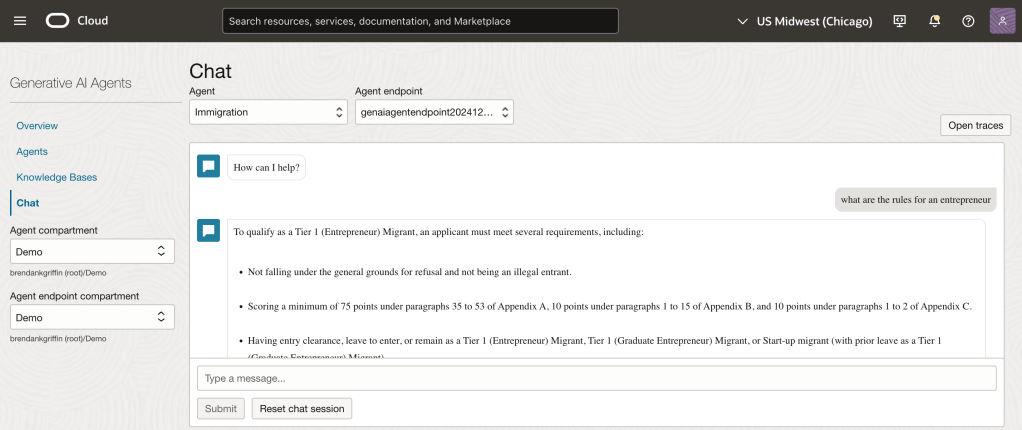
If you want to know more about OCI Generative AI Agents, be sure to check out this short video that I created that walks through the end-to-end process of creating an agent in less than 10 minutes ⏱️.
Anyway……back to the main topic. The advantage of using Streamlit is that it enables custom web apps to be created in minutes, which are highly customizable and therefore perfect for PoCs to demonstrate the art of the possible .
Before I jump into sharing the code, this is how the end result looked (running locally on my Mac, will also work on Windows too) – using an agent that I developed to help understand UK immigration policy 📄. Here I am asking about the rules for an entrepreneur.
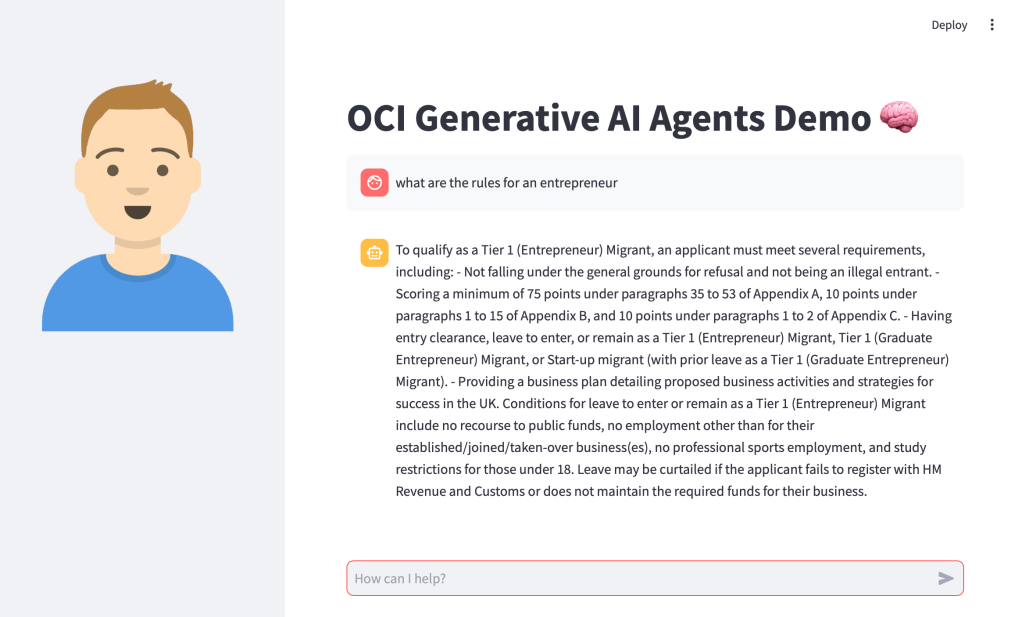
Installing Streamlit is a breeze using the single command below.
pip install streamlit
Once I’d done this, I put together the following Python script to create the web app, this can also be downloaded from GitHub.
Disclaimer: I’m no developer and this code is a little hacky, but it gets the job done!
The following variables need to be updated before running the script – further info can be found in the code comments:
- st.title – Set’s the title of the page
- st.sidebar.image – Configures the image to use in the sidebar
- config – Set’s the OCI SDK profile to use, further info on this can be found here – https://docs.oracle.com/en-us/iaas/Content/API/Concepts/sdkconfig.htm
- service_ep – Defines the Generative AI Agent service endpoint to connect to (this varies by region)
- agent_ep_id – Sets the OCID of the agent to connect to
import streamlit as st
import time
import oci

# Page Title
st.title("OCI Generative AI Agents Demo 🧠") # Update this with your own title

# Sidebar Image
st.sidebar.image("https://brendg.co.uk/wp-content/uploads/2021/05/myavatar.png") # Update this with your own image

# OCI GenAI settings
config = oci.config.from_file(profile_name="DEFAULT") # Update this with your own profile name
service_ep = "https://agent-runtime.generativeai.us-chicago-1.oci.oraclecloud.com" # Update this with the appropriate endpoint for your region, a list of valid endpoints can be found here - https://docs.oracle.com/en-us/iaas/api/#/en/generative-ai-agents-client/20240531/
agent_ep_id = "ocid1.genaiagentendpoint.oc1.us-chicago-1.amaaaaaaayvpzvaa7z2imflumr7bbxeguh6y7bpnw2yie4lca2usxrct" # Update this with your own agent endpoint OCID, this can be found within Generative AI Agents > Agents > (Your Agent) > Endpoints > (Your Endpoint) > OCID

# Response Generator
def response_generator(textinput):
    # Initialize service client with default config file
    generative_ai_agent_runtime_client = oci.generative_ai_agent_runtime.GenerativeAiAgentRuntimeClient(config,service_endpoint=service_ep)

    # Create Session
    create_session_response = generative_ai_agent_runtime_client.create_session(
        create_session_details=oci.generative_ai_agent_runtime.models.CreateSessionDetails(
            display_name="USER_Session",
            description="User Session"),
        agent_endpoint_id=agent_ep_id)

    sess_id = create_session_response.data.id

    response = generative_ai_agent_runtime_client.chat(
        agent_endpoint_id=agent_ep_id,
        chat_details=oci.generative_ai_agent_runtime.models.ChatDetails(
            user_message=textinput,
            session_id=sess_id))

    #print(str(response.data))
    response = response.data.message.content.text
    return response

# Initialize chat history
if "messages" not in st.session_state:
    st.session_state.messages = []

# Display chat messages from history on app rerun
for message in st.session_state.messages:
    with st.chat_message(message["role"]):
        st.markdown(message["content"])

# Accept user input
if prompt := st.chat_input("How can I help?"):
    # Add user message to chat history
    st.session_state.messages.append({"role": "user", "content": prompt})
    # Display user message in chat message container
    with st.chat_message("user"):
        st.markdown(prompt)

    # Display assistant response in chat message container
    with st.chat_message("assistant"):
        response = response_generator(prompt)
        write_response = st.write(response)
    # Add assistant response to chat history
    st.session_state.messages.append({"role": "assistant", "content": response})
Once this file has been saved, it’s simple to run with a single command:
streamlit run OCI-GenAI-Agents-Streamlit.py
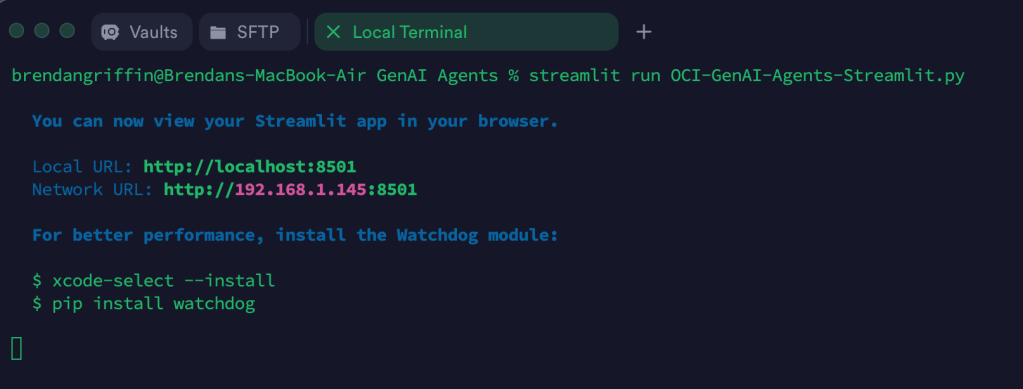
It will then automatically launch a browser and show the web app in action 🖥️
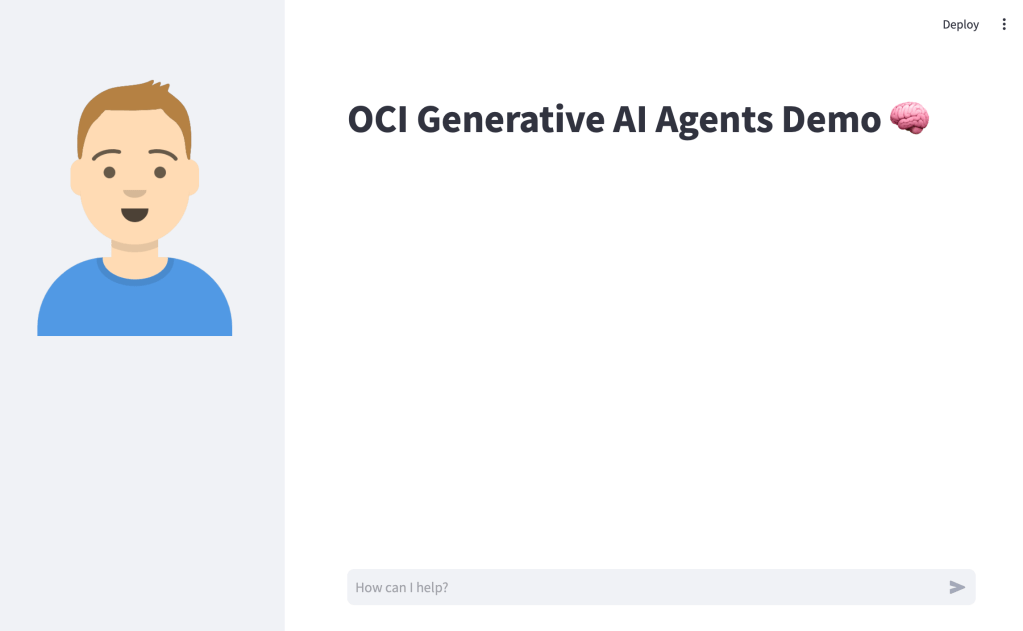
This basic example can easily be updated to meet your requirements, the Streamlit documentation is very comprehensive and easy to follow with some useful examples – https://docs.streamlit.io/.


Leave a reply to Brendan’s Tech Ramblings Cancel reply